Norfolk Cricket Society is delighted to invite cricket enthusiasts to a special evening with former England international cricketer James Taylor on Thursday 26th March. This unique event offers a rare opportunity to hear first-hand from one of England’s most talented modern batsmen as he reflects on his cricketing journey, the highs and challenges of professional sport, and the heart condition that brought his playing career to an unexpected early end.
James Taylor
James Taylor was widely regarded as one of the most technically gifted batsmen of his generation. His professional career began with Leicestershire, where his exceptional batting talent became clear from a young age. He later moved to Nottinghamshire, where he continued to develop into one of the most reliable and stylish batsmen on the county circuit. His consistent performances earned him international recognition, and he made his ODI debut for England in 2011 and Test debut versus South Africa in 2012.
Across his international appearances in Test cricket (7) and One Day Internationals (27), he earned a reputation as a player who combined grit with elegance at the crease. However, in April 2016, at the age of just 26 and at the peak of his career, he was forced to retire from professional cricket after being diagnosed with a serious heart condition.
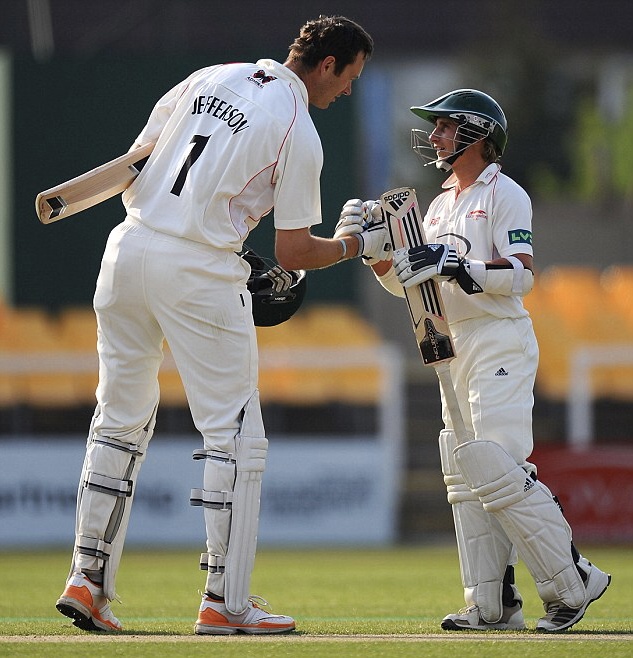
Former Horsford CC & Norfolk CCC batter Will Jefferson and James Taylor
During the evening, James will speak openly about receiving this diagnosis, the difficult decision to step away from the sport he loved, and how he adapted to life after professional cricket. His story is not only about cricketing success but also about resilience, perspective, and the importance of health and wellbeing.
There will also be a question-and-answer session, giving audience members the chance to put their own questions directly to James. Whether you want to ask about his experiences playing international cricket, or how he navigated such a sudden career change, this is a rare opportunity to engage with a former England player.
The event starts at 7pm at Horsford Cricket Club. Entrance for non-members is £7, cash payable on the door.
A veritable man for all seasons kept an appreciative audience royally entertained as Norfolk Cricket Society’s first guest speaker of 2026 on Thursday 26 February.
Since making his first-class debut in 1980, Simon Hughes has been a hardy perennial of the cricketing world at home and abroad, collecting multiple honours on and off the field as a fast-medium bowler for Middlesex and Durham, as an award-winning author and journalist, and as “The Analyst” on Channel 4’s innovative Test match coverage, before reprising the role on his Inside Cricket podcast with Simon Mann.
He told a packed room at Manor Park about blissful summers spent at Canterbury in the 1970s, watching the all-conquering Kent side, full of top internationals, before embarking on his own professional career at Lord’s.
Hughes entered a Middlesex dressing room full of star names and diverse characters, including captain Mike Brearley, Mike Gatting, Roland Butcher, Philippe Edmonds and Wayne Daniel, and in later years Phil Tufnell and Angus Fraser.
He described his first experience of bowling to Geoffrey Boycott, dismissing him only to hear the call of “no-ball”, and the ordeal of facing the blistering pace of West Indians such as Malcolm Marshall and Sylvester Clarke as a quaking tail-end batsman.
Hughes won a string of trophies in 12 seasons with Middlesex under Brearley and Gatting, including four County Championship titles, and enjoyed a benefit year in 1991 before spending his final two seasons on the county circuit with Durham on their entry into first-class cricket.
This involved playing, as well as drinking and dining with the one and only Ian Botham, an exhilarating, exhausting and expensive business.
Hughes rated Boycott, Botham and Shane Warne as three prime examples of the unshakeable self-belief needed to succeed in cricket at the highest level. Hughes and Warne never faced each other on the field, but the great leg-spinner often discussed his game with The Analyst during his broadcasting days, notably in the unforgettable 2005 Ashes series.
The disappearance of live Test cricket from terrestrial TV after the 2005 Ashes was a cause of deep regret for Hughes, who regarded it as a lost opportunity to build on the fresh public interest generated by the series and promote the game, with only a third of the population able to access today’s satellite coverage.
He believes the current standard of TV cricket commentary is the worst for years with notable exceptions such as Michael Atherton, Nasser Hussain and the man he regards as the best of the broadcasters, New Zealander Ian Smith.
Hughes responded to an audience question about reverse swing bowling with a scientific explanation of the art, which he said had been around long before Waqar Younis and Wasim Akram perfected it in the early 1990s, but was not known by the name. He once spent a day investigating the phenomenon of swing bowling in a wind tunnel at Bath University’s aerodynamics department and produced a detailed report of his findings.
It was an evening that went with a swing in every sense.
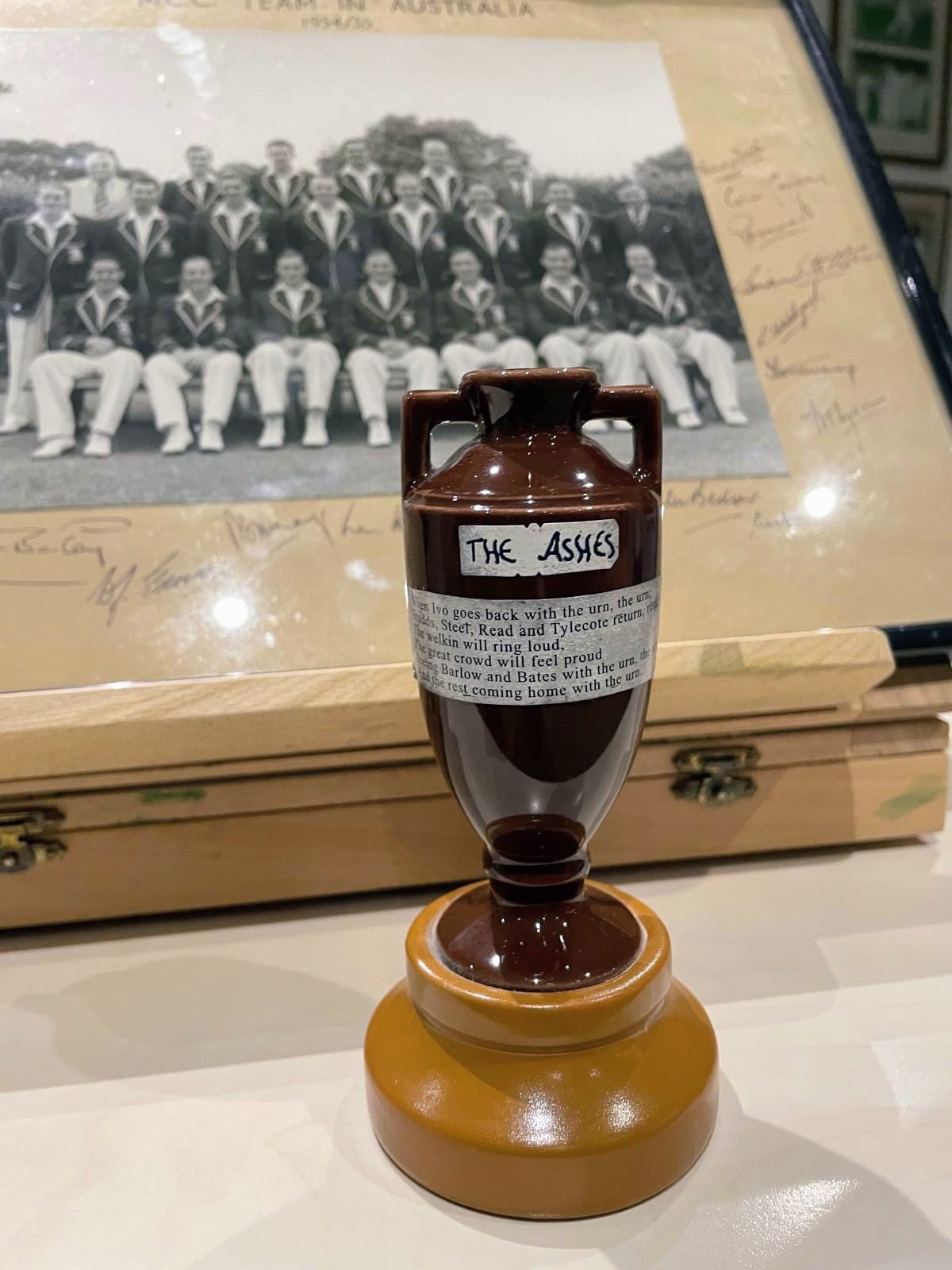
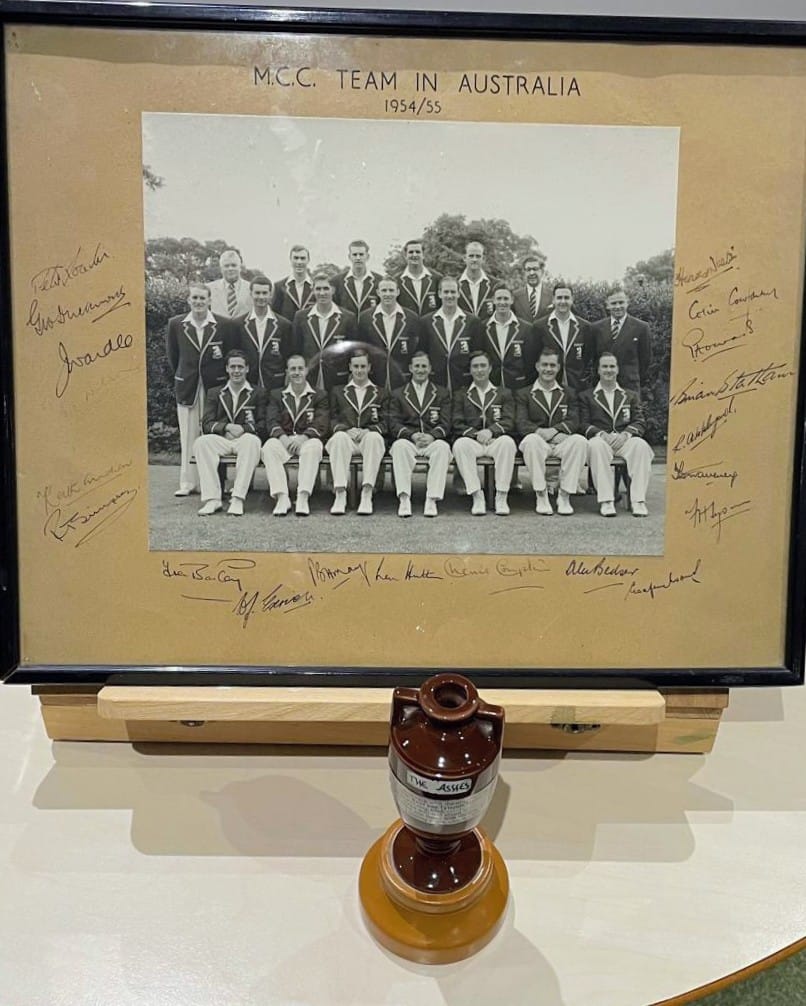
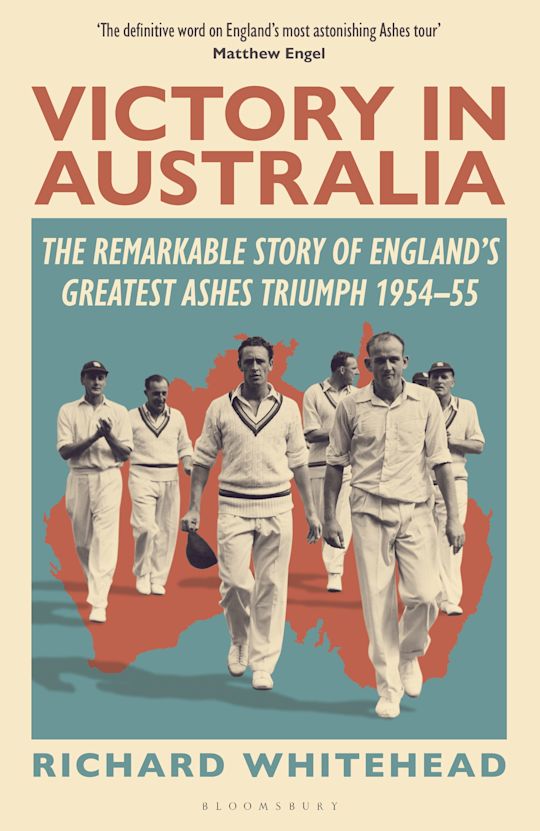
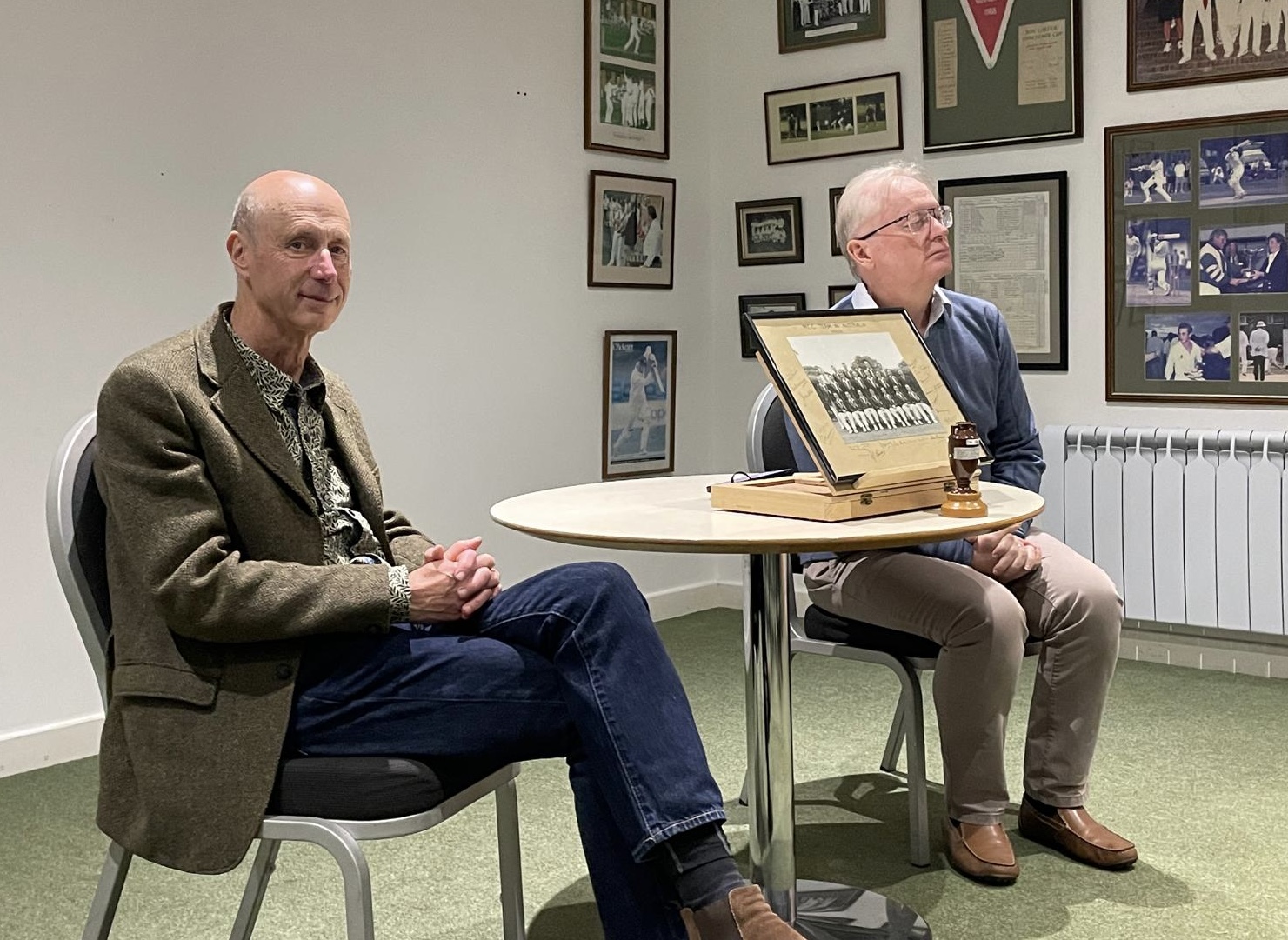
On Thursday 27 November 2025 our speaker was Richard Whitehead, whose topic was the Ashes tour of 1954/55. He has just published a book on this tour, entitled Victory in Australia. The Remarkable Story of England’s Greatest Ashes Triumph 1954-55. He was accompanied by David Woodhouse, the author of Who Only Cricket Know: Hutton’s Men in the West Indies 1953/54. They did not present a formal question-and-answer session but rather a conversation, led by Richard with David chipping in at appropriate times. This format worked extremely well.
The subject was presented in a well-structured fashion. Richard began by discussing the issue of the captaincy, describing how the MCC hierarchy were keen to replace Len Hutton, then England’s skipper but a professional, with David Sheppard, an amateur with impeccable credentials. However, their plan failed to come to fruition and Hutton remained in post. Richard then described how the omission of Fred Trueman from the touring squad was greeted with hostility from some sources and pointed out that the largely forgotten Jim McConnon was selected as an off-spinner ahead of Jim Laker.
Richard then dealt with the Tests in order. He pointed out that Hutton made a very poor decision by going into the first Test with no spinner and putting the Australians into bat: the hosts totalled 601 for eight before declaring and won by an innings and 154 runs. He then described how the quick bowling of Frank Tyson (famously) and Brian Statham, and the batting of the young amateurs, Peter May and Colin Cowdrey, enabled the tourists to turn the series around and win by a margin of three Tests to one. Richard justified his choice of subtitle for his book, providing evidence that this was indeed ‘England’s Greatest Ashes Triumph’.
Hutton came in for more criticism for his handling of Alec Bedser. The latter had been England’s finest bowler since the War and was expecting to play in the second Test. He only learned of his omission when he read the team-sheet posted in the dressing room immediately before the match. Richard justifiably described this as a very poor piece of man-management by Hutton, whose somewhat eccentric behaviour during the tour clearly indicated that he felt under considerable pressure.
Tailoring his presentation to his location, Richard discussed the involvement in the tour of Bill Edrich, a ‘bad boy’ whose fighting, if not his drinking, qualities apparently endeared himself to Hutton.
Richard Whitehead and David Woodhouse
Questions were then taken. It is an indication of the interest generated that these were many in number and detailed in nature. Richard answered these questions in a most knowledgeable fashion, and it was apparent that he had researched this tour in a most exhaustive and praiseworthy fashion. David’s book was a multi-award-winner and, if there’s any justice, Richard’s work will be similarly lauded.
All-in-all this was one of the most memorable evenings that the Norfolk Cricket Society has hosted for many a long year.
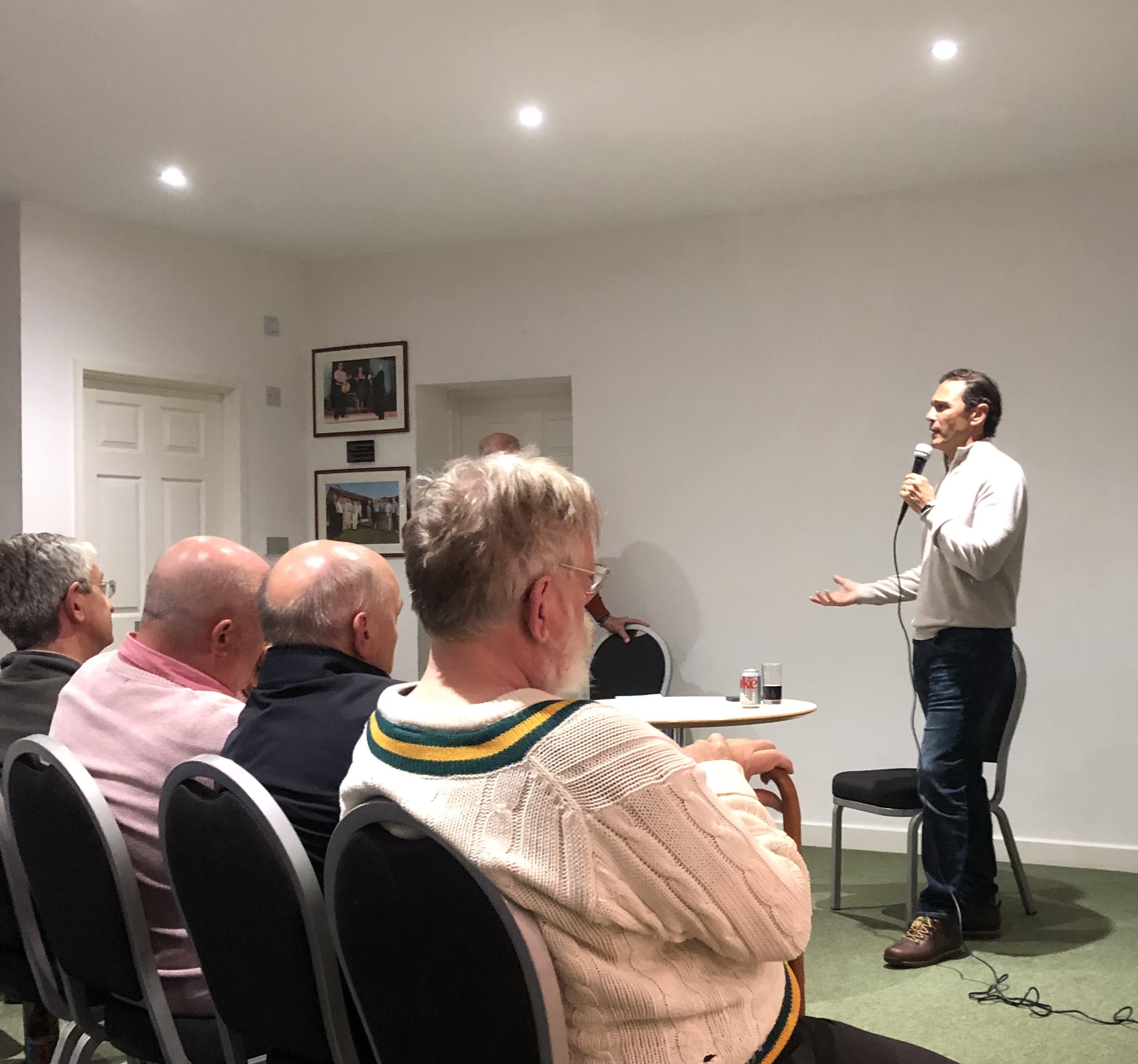
Norfolk Cricket Society is pleased to announce that Australian cricket journalist Jarrod Kimber will be joining us as our guest on Monday 22 September (7.30pm) at Horsford Cricket Club in Norwich.
Jarrod has written several books on cricket, he is a regular on talkSport, and also co‑directed and co‑wrote the award-winning 2015 documentary film Death of a Gentleman, an expose of the power-play governance of cricket by the ICC’s so‑called “Big Three”. In July 2024 Jarrod joined The Cricketer magazine as a regular columnist.
Beyond journalism and filmmaking, Jarrod has also worked as an analyst for the St Lucia Stars in the Caribbean Premier League and for the Scotland national team.
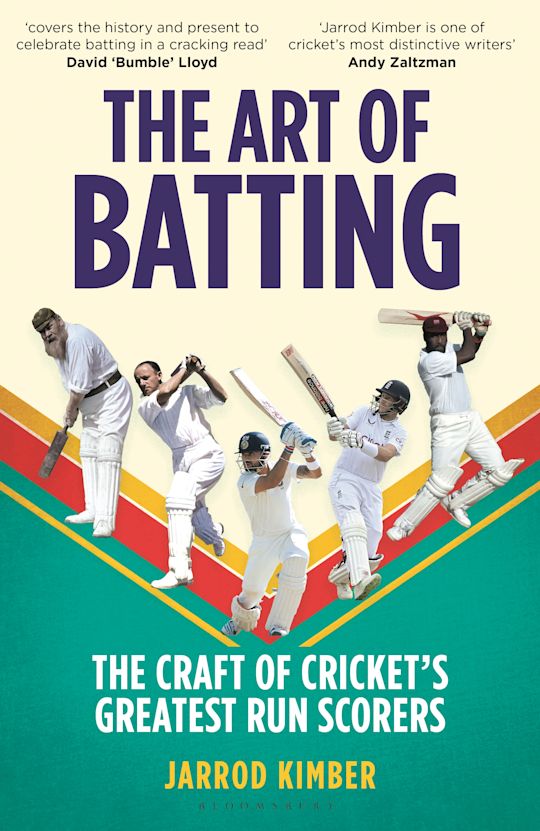
Released in July 2025, The Art of Batting: The Craft of Cricket’s Greatest Run Scorers is Jarrod’s latest book. Through interviews with cricketing greats such as David ‘Bumble’ Lloyd, Nasser Hussain, Rahul Dravid, and Brian Lara, The Art of Batting reveals the science, skill, and culture that made the 50 greatest batters of all time.
The book is about the batters who see what mortals don’t: Javed Miandad deliberately making errors to manipulate the field; Sachin Tendulkar digging up a pitch to take on Shane Warne; Shivnarine Chanderpaul relentlessly practising on a beach to master his technique; and Joe Root playing against spin as a result of three random events. Jarrod frames these players as artists who do more than bat—they “see into the future,” mastering the unpredictable with precision.
Andy Zaltzman labels Jarrod Kimber “one of cricket’s most distinctive writers,” and Harsha Bhogle praises the masterful use of analytics and vocabulary. Wright Thompson of ESPNcricinfo declares that Kimber “further cements himself as the world’s best cricket writer” with this work.
Entrance for guests is £7, payable on the door.
Copies of The Art of Batting (RRP £20) will be available to purchase with a special discount for Norfolk Cricket Society members and guests.
David Walker was arguably the best batsman of the 1930s never to play full-time in the First Class game with legendary Norfolk, Middlesex and England cricketer Bill Edrich going as far to say that “With the possible exception of Donald Bradman, David Walker was probably the best batsman in the world!”
David played for Norfolk from 1931 – 1939, topping the averages on seven occasions. In those nine seasons he was often only available for a few games because of studies and work commitments but scored almost 4,000 runs in Championship games – including thirteen centuries and two double centuries – at an average of 63.44.
Tragically, David died in February 1942 when the RAF bomber plane he was flying in was shot down off the Norwegian coast.
David Walker: Norfolk’s Master Batsman – written by Andy Dawson, a previous guest speaker at Norfolk Cricket Society – draws on contemporary accounts, intimate letters and photos from the archive of David’s family, and the testimonies of those who knew him during his brief life.
Reviews
“redolent of a different time and social structure and vividly brought to life by a writer for whom this was obviously a labour of love.
We held six events in 2024/25 and were joined by some brilliant guest speakers: here’s how it went.
Mark Ramprakash, Thursday 26th September 2024
Former England batter and batting coach Mark Ramprakash, who starred for both Middlesex and Surrey, was an inspired choice of speaker as he opened the innings for the Society’s 2024-25 programme in September.
Ramprakash, who played 52 Tests and scored 114 first-class centuries, provided great entertainment and humour for an appreciative audience at Manor Park, and his recollections were not confined to cricket.
He recalled his early days in a Middlesex dressing room brimming with world-class players, and his introduction to the England side under Graham Gooch against the West Indies in 1991.
He described encounters with Australian legends Merv Hughes and Shane Warne in the 1990s, and the catch that dismissed Justin Langer to turn the tide of the Ashes Test in Melbourne in 1998.
It was after moving to Surrey in 2001 that he became most prolific with the bat. But he also became a household name with non-cricket followers for his brilliance on the dance floor as the winner with Karen Hardy of the BBC’s Strictly Come Dancing in 2006, and he recalled inviting three of his Surrey team-mates into the audience for one of his shows.
Now president and batting coach for Middlesex and director of cricket at Harrow School, Ramprakash also discussed his long friendship and years as team-mate for Surrey and England with the late Graham Thorpe.
Ben Bloom, Thursday 24th October 2024
October saw Ben Bloom visit the society and give a talk about his book, ‘Batting for Time – The Fight to keep English cricket alive’. As befitting someone who has been a sports journalist since 2010 and has written for The Telegraph, the BBC, The Guardian, The Times, Daily Mail, and numerous other outlets, Ben demonstrated an ability to compartmentalise information, opinions and topics in ways that brought clarity to a complicated subject.
With the rise of franchise cricket and the amounts of money that The Hundred has generated, there’s no doubt that these are turbulent, disorientating times for the game, and Ben adopted the same role when talking at our Society as he fulfils in the book: sharing the outputs from more than 100 interviews and hours of research in a precise, impartial manner. He values the joys of the County Championship but also recognises the importance of evolution. Ben would make a good surgeon: not unduly influenced by emotion, a clear thinker, and able to make steady-handed, surgical incisions when required. Despite his diligent work, it’s clear that cricket in England (and beyond) is currently a riddle without obvious solutions. Different market forces are in conflict and the questions around what we expect from our domestic game, who it primarily exists for and where things might go in the future will continue to be asked for the foreseeable future.
For valid reasons, Ben’s excellent talk – and his answers to numerous questions thereafter – could not entirely have reassured the audience’s diehard traditionalists but they, like all of us, were left better informed with new perspectives and insights.
Simon Lister, Thursday 28th November 2024
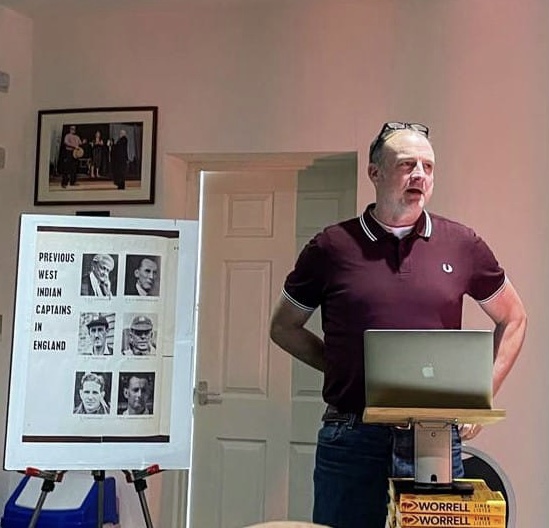
Award-winning author Simon Lister was the guest speaker for November, when he discussed the life and career of West Indies captain Sir Frank Worrell, the subject of his highly-acclaimed biography, “Worrell: The Brief but Brilliant Life of a Caribbean Cricket Pioneer”, subsequently announced as the winner of the MCC/Cricket Society Book of the Year 2025.
The author, a senior BBC News producer in addition to being one of today’s foremost cricket writers, is an authority on Caribbean cricket, and became an avid follower of the West Indies after being taken to The Oval in the scorching summer of 1976.
He described how Worrell, born in Barbados, overcame the prejudice, elitism, injustice and island rivalries that dogged cricket in the Caribbean to become the first permanent black captain of the West Indies in 1960 and gain worldwide admiration for transforming a hugely talented but inconsistent group of players into the most exciting team in the world. He led his side to a 3-1 series win in England in 1963, after which he retired.
Worrell was knighted for services to cricket in 1964, but three years later, he died from leukaemia at the age of 42, not before making his mark in the world of education and politics.
The author, whose other works include another Book of the Year winner, Fire In Babylon, and the authorised biography of Clive Lloyd, answered questions on the decline of the West Indies as a force in world cricket, the dwindling support for Test cricket in the islands and the reduced following for the team during their appearances in England, a downward trend he feels will not be reversed.
Jeremy Lonsdale, Thursday 27th February 2025
(Image c/o Adam Pryke)
The Society’s winter programme resumed in February with the visit of another acclaimed writer, Jeremy Lonsdale, an authority on Yorkshire cricket.
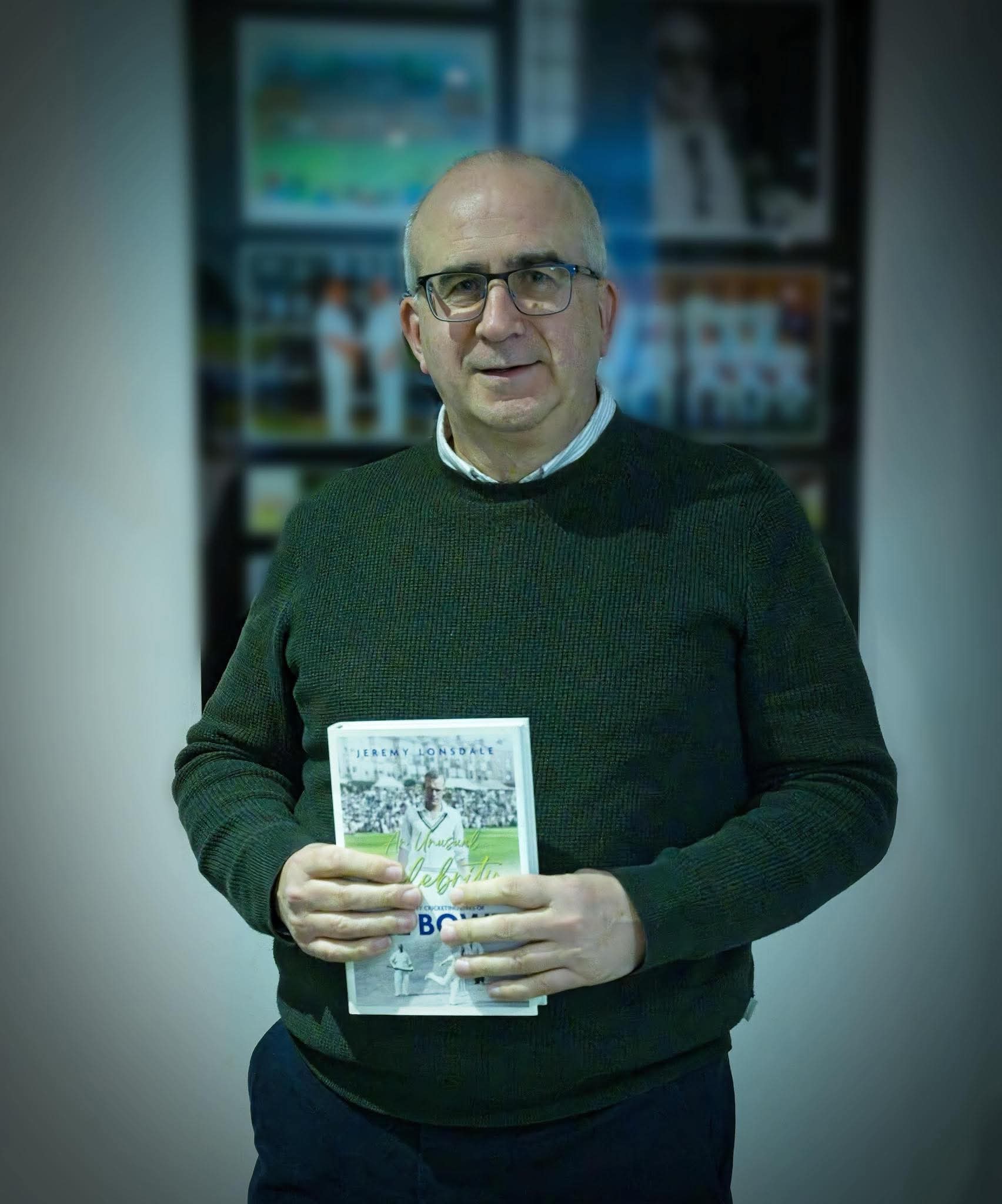
He discussed his latest work, “An Unusual Celebrity: The Many Cricketing Lives of Bill Bowes”.
The author met the Yorkshire and England fast bowler just once, when he was pushed forward to secure his autograph at Scarborough years after he retired, but he painted a vivid picture of one of the most popular figures in Yorkshire history, whose renown extended in later years as a coach, journalist and broadcaster.
Bowes played 15 Tests and was a major player in Yorkshire’s successes between the wars as a devastating opening bowler, forever remembered for bowling Don Bradman first ball at Melbourne in 1932 during the famous “Bodyline” Ashes series, his only appearance during the series and the first of five occasions when he dismissed Bradman. He took 1,639 first-class wickets, 68 in Tests.
An unlikely sporting hero, Bowes was tall, bespectacled and ungainly. His comparatively short run-up was described as economical and he relied more on lift and movement than raw speed, though he became a controversial figure, accused of over-using the “bumper”.
After being captured in North Africa in 1942, he spent three years as a prisoner of war but returned to play two more seasons of cricket after the war and bowled the first ball of England’s postwar Test era.
The young Fred Trueman and Brian Close were among those to benefit from Bowes’s coaching expertise, while his other accomplishments included public speaking, magic and film-making.
Graham Gooch, Thursday 27th March 2025
(Image c/o Adam Pryke)
Over the years the Society has welcomed some outstanding Test cricketers. In recent years this has included Mike Brearley, Angus Fraser, Devon Malcolm, Dennis Amiss and Mark Ramprakash. But in March, we arguably reached new heights in welcoming one of England’s greatest ever: Graham Gooch, run-machine and captain of Essex and England.
Gooch was typically in good form, starting with some memories and humorous stories from his long career. Botham, Tufnell, Boycott, Gatting, Emburey and a few umpires all got a mention. Perhaps, though, he was at his best when he talked about the art of batting and the mindset to achieve excellence. Graham picked out the two Richards as his batting role models – Barry for his technical ability, Viv for that assertive body language. He learned from both, recognising that cricket is a ‘one-ball game’. Her explained that what’s gone before is not relevant, and nor is whatever the future holds – all a batter can do is focus on dealing with the next ball as well as they can. He argued that’s a decent metaphor for life as well. With that in mind, he also explained the difference between batting and run-making. Lots can bat, but few have the nous to consistently make runs.
In the second half of the evening, Graham answered questions from the audience on topics such as BazBall and the future of Test cricket and the English domestic game. Few know and have played the game as successfully as Graham so it was no surprise that his views were illuminating and thought-provoking.
Dean Wilson, Thursday 24th April 2025
(Image c/o Adam Pryke)
One of the many benefits of attending talks at the society is learning more about professional cricket behind the scenes. For April talk, we welcomed someone with the perfect CV to meet the brief. Dean Wilson spent 18 years as cricket correspondent at the Daily Mirror and has ghostwritten numerous articles and books with two of English cricket’s most significant modern figures, Ian Botham and Ben Stokes.
Sure enough, whilst talking us through his career and life as a journalist, he provided new information and fresh perspectives on many of the key events and characters he’s observed at close quarters. He was particularly insightful on Kevin Pietersen’s rollercoaster career with England.
A naturally chatty, friendly type, Dean seems to have the ability to build a network of strong relationships, becoming a friend and trusted confidant of players, coaches and administrators alike. This is a task that he admitted has become more difficult to achieve in modern times for all journalists, as media relations become more structured and controlled.
He also outlined the joys and challenges of working with Beefy and Ben and how ghost-writing works in practice.
What became clear is that Dean is an absolute cricket badger, still loving and promoting the game with an undimmed enthusiasm and vast knowledge. These are traits that will hold him in good stead in his new role as a Media Consultant.





 Norfolk Cricket Society